
The Freedom Code
Healing Addiction at the Root7-Session HART & Hypnotherapy Transformation Programme
You have tried to stop before.
Perhaps many times.
And each time — despite your willpower, despite everything you tried — the pull came back.
This is not a failure of character.
It is not weakness.
And it is not who you are.
It is the inevitable result of trying to change a behaviour without ever addressing what is driving it from beneath.
What Addiction Really Is
Addiction is not a moral failing. It is not a disease of willpower.
At its core, addiction is an emotional coping strategy — a way the mind and body learned to manage pain, numbness, shame, fear, or grief that had nowhere else to go.
Whether the addiction is to alcohol, drugs, sex, gambling, food, or love — the mechanism is the same.
Something beneath the surface is in pain.
The addictive behaviour provides temporary relief.
And so the cycle perpetuates.
Not because you are broken — but because the wound has never been healed.
Until the emotional root is addressed, the behaviour will always return. This is not a flaw in you — it is simply how the subconscious works.
The Map of Consciousness — Why Your Emotions Are Driving Everything
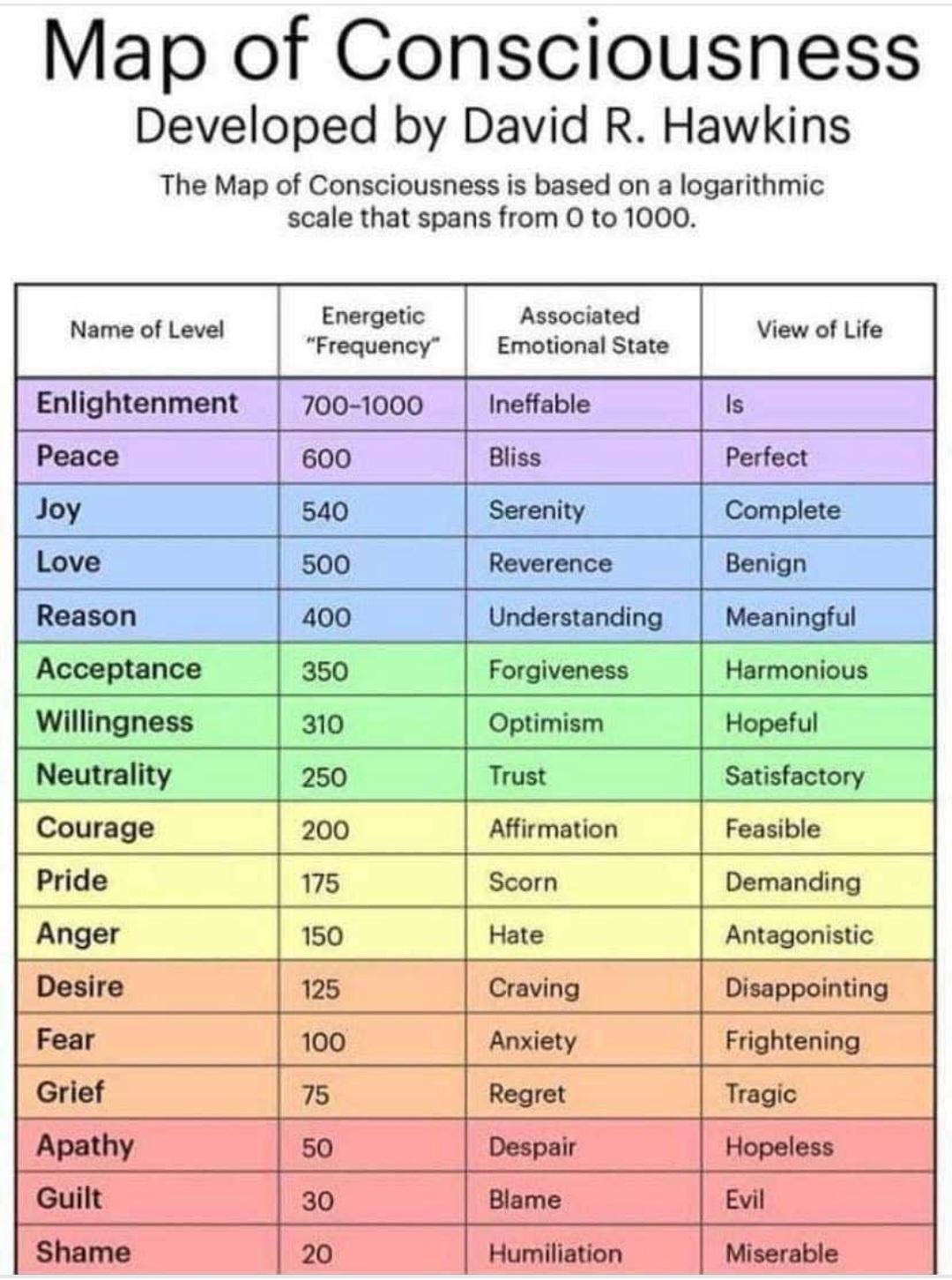
At the heart of The Freedom Code is the Map of Consciousness — a profound model developed by Dr David R. Hawkins, which maps every human emotion to a specific energetic frequency.
The lower the frequency, the more contracted, survival-based, and pain-driven our experience of life becomes.
The higher the frequency, the more expansive, connected, and free we feel.
Every emotion below 200 on the Map is a state of suffering. And every addictive pattern has its roots anchored in these lower frequencies.
Understanding this changes everything.
Because it means that addiction is not a permanent state — it is an energetic one.
And energy can always be shifted.
The Low-Frequency Emotions That Drive Addiction
These are the emotional states that form the hidden architecture of every addictive pattern:
Shame (20) — The Deepest Root
Shame is the lowest survivable frequency on the Map of Consciousness. It sits at the very foundation of human suffering, beneath every other emotional state, beneath every pattern, beneath every behaviour that has ever been used to escape it.
Shame is not guilt. Guilt says I did something wrong. Shame says I am something wrong. It is not a feeling about behaviour. It is a feeling about existence itself. The bone deep, wordless conviction that you are fundamentally defective, that you should not be as you are, that who you are at your core is too much, not enough, unworthy of love, unworthy of belonging, unworthy of the space you occupy in the world.
Hawkins placed shame at 20 Hz, noting that it is barely above the level of physical death. And this is not metaphorical. Shame at this frequency is genuinely life threatening. It drives self destruction, self punishment, and the complete collapse of self worth. It is the wound beneath the wound, the frequency that, when present, colours every other experience and every other emotion that sits above it.
Shame is almost always pre-verbal. It was not learned through a single identifiable moment, though specific moments may have reinforced it. It was absorbed. Breathed in. Taken on in the earliest years of life, often before conscious memory begins, through experiences of abandonment, rejection, abuse, neglect, or simply the chronic absence of the attuned, unconditional love that every child needs in order to know that their existence is welcome and their being is enough.
Because it is pre-verbal, shame cannot be reasoned away. It cannot be argued with, reframed, or thought out of existence. It lives far beneath the reach of the conscious mind, in the body, in the nervous system, in the energetic field, as a felt sense of wrongness so old and so familiar it is no longer experienced as a feeling at all. It is simply experienced as truth.
In addiction, shame is both the deepest driver and the cruellest consequence. The reaching is so often an attempt to escape the unbearable weight of feeling fundamentally wrong. And yet every cycle of addiction, every moment of I did it again, I promised I would not, deposits another layer of shame onto the original wound. The very thing the reaching was trying to escape is the thing the reaching creates more of.
This is the trap at the very bottom of the density. And it is the place where the deepest healing must begin.
When shame is cleared at the root, something that has never before felt safe to exist, begins, quietly and tentatively, to emerge. Not a new self. The original self. The one that was always there, beneath everything that was placed upon it.
The one that was always enough.
Guilt (30) — The Weight of Self-Blame
Guilt tells us we have done something wrong, that we don’t deserve happiness, peace, or freedom.
Hawkins understood guilt at a deeper level than simple remorse. He observed that guilt often has nothing to do with anything we actually did. When we experience abuse, neglect, or violation, particularly in early childhood, before we have the language or cognitive capacity to understand what is happening, the psyche faces an impossible choice. To recognise the truth of what is being done to us is to enter a state of utter powerlessness. And powerlessness at that level is unbearable for a small system to survive.
So instead, the mind does something extraordinarily adaptive. It takes the blame. It decides, beneath the level of conscious thought, often before words even exist, that it must have been our fault. That we caused it. That we deserved it.
This is pre-verbal guilt. It does not live in the thinking mind. It lives in the body and the nervous system as a felt sense of wrongness with no memory attached, no story to point to, no moment we can identify and say, there, that is where it began.
In addiction, guilt creates a devastating cycle. The behaviour generates guilt, and the guilt drives the behaviour. But beneath the guilt about the addiction itself lies this older, deeper, wordless layer, the original decision that we were the cause of our own wounding.
This is not guilt we chose. It is guilt we constructed in order to survive. And it can be released.
Apathy (50) — The Grey Place
Apathy is the frequency of having given up. Not dramatically, not all at once, but quietly, incrementally, over time. It is what happens when a system has been overwhelmed for so long that it has simply stopped believing that anything could be different.
At 50 Hz, the world appears flat. Colourless. The future holds no promise, the present holds no meaning, and the past feels like evidence that effort is pointless. There is no motivation, no forward movement, no spark of possibility. Just a vast, grey stillness that is neither peace nor rest, but exhaustion so complete it has become a way of being.
Hawkins described apathy as one of the most difficult frequencies to move from, precisely because it lacks the energy of the emotions above it. Grief at least hurts. Fear at least has charge. Anger at least moves. But apathy is inert. It does not reach, does not resist, does not fight. It simply… stops. And because it stops, it can feel permanent in a way that other emotional states do not.
In addiction, apathy often arrives after prolonged periods of struggling, of trying and failing, of hope repeatedly disappointed. It is the frequency of I cannot, I will not, what is the point. The addiction at this stage is no longer even providing much relief. It has simply become the only familiar thing in a landscape that has gone entirely grey. Something to do. Something to feel. Proof, at least, that the body is still here.
Beneath apathy, almost always, lies a layer of grief and fear that became too heavy to continue feeling. Apathy is the system’s response to unbearable emotional weight. A kind of internal shutdown, chosen not consciously but by a system that had reached its limit and had no other way to protect itself.
This is why telling someone in apathy to simply try harder, to want more, to choose differently, achieves nothing. The capacity to want has itself been depleted. What is needed is not motivation from the outside. What is needed is a clearing of the density that made the shutdown necessary in the first place.
When apathy begins to lift, it does not always feel immediately like joy. Often the first sign is simply a faint returning interest. A small noticing. A tentative reaching toward something, anything, that feels even marginally alive.
That reaching is not small. That reaching is everything. It is the system remembering, however faintly, that it is still capable of wanting something real.
Grief (75) — The Unprocessed Pain
Grief is the energy of loss, of love, of connection, of the self that existed before the wound.
Many people in addiction are carrying enormous amounts of unprocessed grief. Not only the grief of obvious losses, though those are real and significant. But the quieter, older grief that has no funeral, no acknowledgement, no socially sanctioned space to be felt. The grief of a childhood that did not feel safe. The grief of love that was conditional or absent. The grief of needs that were never met, of a self that learned early to make itself smaller, quieter, less. The grief of years spent in a pattern that was never truly wanted.
This grief does not announce itself clearly. It lives in the body as a heaviness with no obvious cause, a sadness that surfaces without warning, an ache that has been present for so long it has become background noise. It is often mistaken for depression, for sensitivity, for simply the way things are.
Hawkins placed grief at 75 Hz, noting its quality of bereavement and despondency. There is a particular kind of exhaustion that accompanies grief at this frequency, a depletion that goes beyond tiredness into something that feels cellular. As though the loss has been absorbed into the body itself and is being carried there, quietly and invisibly, year after year.
Addiction numbs the pain of grief. The reaching temporarily lifts the heaviness, creates a moment of warmth or aliveness in a system that grief has made cold and flat. But numbing is not healing. The grief remains, untouched beneath the surface, and often deepens as the losses that accompany addiction accumulate on top of the original wound.
What grief truly needs is not numbing. It needs to be witnessed, felt, and gently, thoroughly released. When grief is cleared at the energetic level, something that has been braced against the pain for a very long time is finally allowed to soften.
And in that softening, something returns. A warmth. A tenderness. A reconnection to the self that was there before the loss.
Fear (100) — The Survival State
Fear keeps us trapped in survival mode, hypervigilant, unsafe, unable to trust ourselves or others.
At 100 Hz, fear is rarely the acute terror of an obvious threat. More often it is a chronic, low-level hum beneath the surface of everyday life. A persistent sense that something is wrong. That the world is not safe. That you are not safe, even within yourself. The nervous system, having learned at some point that danger was present, never fully received the signal that it was over. And so it stays braced. Waiting.
Hawkins understood fear as one of the most debilitating frequencies on the scale, not because of its intensity, but because of its constancy. The body held in permanent threat response has very little resource left for healing, for joy, for genuine connection. It is simply too busy surviving.
In addiction, fear operates on multiple levels. There is the fear that drives the reaching in the first place, the nervous system seeking anything that will lower the alarm. There is the fear of feeling, of stopping, of what might surface if the behaviour is removed. And beneath all of these sits the original fear, learned so early and so completely that it no longer registers as fear at all. It simply registers as reality.
This is why change can feel dangerous even when it is deeply wanted. The body does not distinguish between the threat that was and the life that is now.
When fear is cleared at the root, the body begins, perhaps for the first time — to exhale.
Desire & Cravings (125) — The Relentless Pull
Desire is the energetic frequency of craving itself. At this level, the mind becomes consumed by wanting — and the wanting itself becomes its own form of suffering.
Desire is never truly satisfied. It simply generates more desire.
This is the frequency of the reach. The drink. The relationship you know isn’t right. The food, the scrolling, the spending. The behaviour you have tried to stop, many times. Whatever form it takes in your life, this is your addiction. And what you are reaching for is never really the thing itself, it is the relief from the weight of everything beneath it. The shame, the grief, the fear, the apathy that has lived in your system for so long it has become the atmosphere of your inner world. Desire at 125 Hz feels like surfacing from that weight. Like air. Like being alive again. And so the system reaches for it, not from weakness, not from failure of will, but because it is the highest frequency available when everything below it is uncleared and unresolved.
The tragedy is not the reaching. The tragedy is that desire at this frequency can never deliver what it promises. It can temporarily mask the density beneath, but it cannot dissolve it. When the relief fades, the weight returns. And now with the added burden of shame about the reaching itself. The cycle tightens. The relief grows shorter. The reaching comes sooner.
This is not a willpower problem. This is a frequency problem. And frequency can be cleared.
The Beliefs That Keep You Locked In
Beneath every addictive pattern is a set of deeply held subconscious beliefs — formed in childhood, quietly operating beneath conscious awareness:
- I am not enough
- I don’t deserve to be happy or free
- I am fundamentally broken
- I cannot trust myself
- I need this to cope
- Things will never change
- I am my addiction
- I don’t know who I am without this
- My needs don’t matter
- I am alone in this and always will be
- The real me is unlovable
- If people really knew me, they would leave
- I am permanently damaged by what happened to me
- I am too much and never enough at the same time
- I am beyond help
- Something is wrong with me at my core
- I have to earn my right to exist
- I don’t deserve to take up space
- Love always comes with conditions
What Happens as You Rise in Frequency
As the emotional imprints beneath addiction are released, something profound begins to happen.
Your consciousness rises naturally along the Map of Consciousness — not through effort or force, but as the inevitable result of releasing what has been weighing you down.
- Courage (200) — the turning point. From survival to choice. From force to power.
- Neutrality (250) — emotional stability. The ability to simply let things be.
- Willingness (310) — openness, hope, the genuine desire to grow.
- Acceptance (350) — inner peace. The releasing of resistance.
- Love (500) — the natural state of the healed heart.
- Joy (540) — aliveness, presence, the experience of life as gift.
Freedom is not something you have to strive for.
It is what remains when the weight is lifted.
How HART & Hypnotherapy Heal Addiction at the Root
The Freedom Code uses the Heart Awakening Revolution Therapy (HART) methodology combined with clinical hypnotherapy to access the level where addictive patterns truly live — in the subconscious, the nervous system, and the energetic body.
This is not talk therapy. This is not willpower. This is not symptom management.
Working directly with your Superconscious — the deeper intelligence within you that already knows how to heal — HART locates the root causes of addictive patterns, releases the emotional imprints that sustain them, clears the beliefs that confirm them, and allows the entire system to return to its natural state of balance and freedom.
You do not need to relive painful experiences.
You do not need to have the right words.
Your Superconscious already knows the way.
Your 7-Session Freedom Journey
Each session is 2 hours, held online, one-to-one, in a private and sacred space. Sessions are spaced fortnightly to allow deep integration between each one.
Session 1 — Shame
We begin at the deepest root. The core wound of I am bad, I am defective, I am unlovable is gently located and cleared at the subconscious level. This is the most transformative session of the entire journey. Nothing that follows is possible without beginning here.
Session 2 — Disempowering Beliefs
With shame beginning to clear, we address the belief system it created, the subconscious stories that have kept you locked in the cycle of addiction. The beliefs that say I am broken, I cannot change, I don’t deserve to be free. As these dissolve, a new and truer narrative begins to take their place.
Session 3 — Guilt
We dissolve the weight of self-blame and the belief that you don’t deserve to be free. Much of this guilt is pre-verbal, absorbed before you had the words for it, taken on in the earliest years of life as a way of making sense of what was happening around you. As guilt lifts, genuine self-compassion begins to emerge, perhaps for the first time.
Session 4 — Apathy
We work with the grey place of depletion and resignation, the frequency of having given up. Apathy is what happens when a system has been overwhelmed for so long it has stopped believing anything could change. As this layer clears, something begins to stir beneath the flatness. A faint but unmistakable returning sense of possibility. The spirit beginning to remember that it is still alive.
Session 5 — Grief
We tend gently to the unprocessed pain beneath the surface, loss, abandonment, heartbreak, the self that existed before the wound. Grief that has never been witnessed, never been given space, never been allowed to move. As it releases, a tenderness returns. The heart, so long braced against the pain, begins quietly and safely to open again.
Session 6 — Fear
We clear the survival states that have kept your nervous system permanently braced and your body locked in threat response. The chronic low-level hum of unsafety that has shaped how you move through the world, what you allow yourself to want, and how much space you permit yourself to take up. As fear clears, the nervous system begins, perhaps for the first time, to exhale. A profound and embodied sense of safety begins to emerge.
Session 7 — Desire & Cravings
In the final session, we work directly with the energetic frequency of craving itself. By this point, the entire emotional foundation beneath the addiction has been cleared, the shame, the guilt, the apathy, the grief, the fear that made the reaching feel necessary. With the density gone, desire loses the charge that has driven it. What remains is not the absence of wanting, but the liberation of it. This is where lasting freedom is anchored.
Your Investment
The Freedom Code — 7-Session HART Transformation Programme
7 x 2-Hour Sessions | Fortnightly | Online | £1,777
This is a high-ticket transformation programme designed for those who are ready to go all the way — to clear addiction at its deepest root and step fully into freedom.
You have carried this long enough.
The Freedom Code is not another thing to try and fail at.
It is an invitation to heal at the level where all of this began.
You are not your addiction. You never were.
You are someone who has been in pain — and pain, at its root, can always be healed.
Welcome to The Freedom Code.
Welcome to your freedom.
FAQs
Is the Freedom Code available online?
Yes. All 7 sessions are held online, one to one, in a private and confidential space. Sessions are available to women across the UK and internationally.
How is this different from traditional addiction therapy or counselling?
Traditional approaches to addiction typically work at the level of behaviour and conscious thought. The Freedom Code works at the level of the subconscious mind, nervous system, and energetic body — where the emotional patterns driving the addiction are actually stored. Using HART therapy, we clear the root cause rather than manage the symptom.
Do I need to have tried other therapies first?
No. The Freedom Code works as a standalone programme. Many clients come having already tried CBT, counselling, or 12-step programmes and found that something deeper remained unresolved. Others come to HART as their first step. Both are welcome.
How long does the Freedom Code take?
The programme runs across 7 sessions, each 2 hours long, spaced fortnightly. This allows deep integration between sessions and gives your system time to recalibrate after each clearing.
What kinds of addiction does the Freedom Code work with?
The Freedom Code works with any compulsive or addictive pattern — alcohol, love and relationship addiction, emotional eating, compulsive spending, scrolling, people pleasing, and any behaviour used to seek relief from emotional density. If you are unsure whether this programme is right for your situation, please get in touch.